
Before June 13, 2023, Richard Lockhart’s life was defined by activity and service. A 37-year-old Air Force veteran, Richard lived with the disciplined energy of someone who refused to sit still. If he wasn’t at the gym pushing his personal bests, he was on his bike or on a walk, enjoying Oregon’s outdoors with his family. He was a fixture in the community, dedicated to coaching his nephew’s baseball team and teaching a new generation the value of teamwork and persistence. Whether it was a quiet morning spent fishing or a weekend project at home, Richard was a man who showed up — for his family, for his players, and for his country.
That all changed in a split second on the Fremont Bridge. Following his workout, Richard was headed to a morning appointment, sitting in stop-and-go traffic, when the world as he knew it ended in his rear view mirror.

Richard (left) on a family fishing trip.
Anatomy of a catastrophe
The impact was not an accident; it was the result of a systemic collapse of safety. Behind Richard sat a 35,000-pound Freightliner semi-truck operated by CORB, Inc. The driver, Yevgeniy Mutz, had been behind the wheel for a staggering 18 hours and 5 minutes. Federal law strictly prohibits commercial driving beyond 11 hours to prevent precisely what happened next: a fatigued driver failing to react to stopped traffic.
Traveling at 55 mph, the truck slammed into Richard’s Subaru, crushing the vehicle and pinning Richard inside the wreckage. The violence of the collision resulted in a catastrophic spinal cord injury, leaving Richard with permanent T4-level paraplegia. In an instant, the man who coached from the dugout and biked for miles was robbed of the ability to feel or move from the chest down.
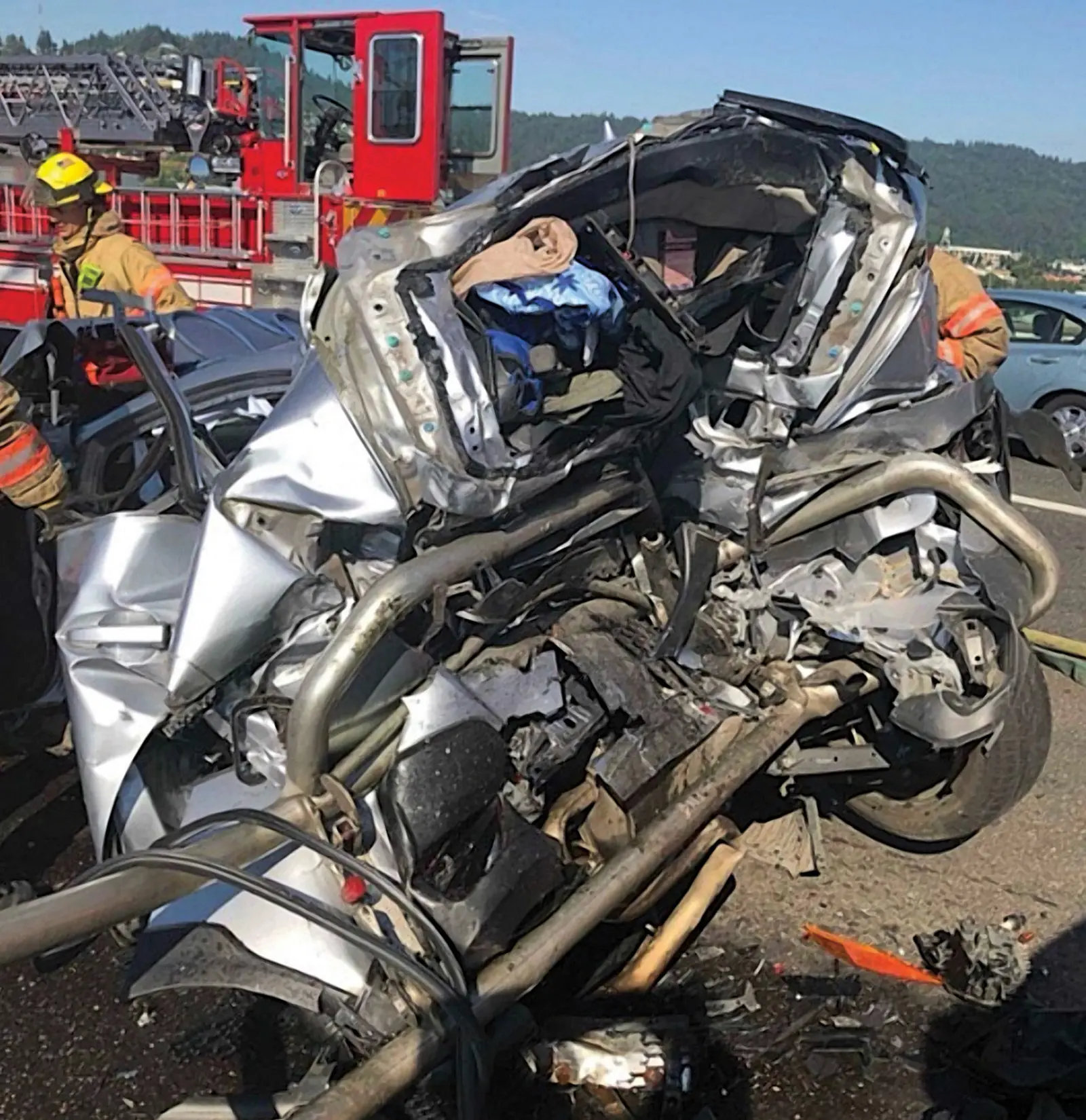
Richard’s car, almost unrecognizable after the collision.
Legal hurdles: Defiance and deception
While the physics of the crash were clear, the path to justice was blocked by the defendants’ calculated obstruction. The Coopers LLP trial team — Andrea Posey, Corey Jollie, and Miles Cooper — faced a defense that was as reckless in the courtroom as they were on the road:
- Willful ignorance: Under oath, the owner of CORB, Inc. admitted he found federal safety regulations “hard to understand” and confessed he hadn’t even bothered to check his driver’s logs after the crash.
- The shell game: As the litigation progressed, the Coopers team uncovered evidence that the defendants were attempting to move assets and shield themselves from the financial reality of the harm they caused.
Coopers’ strategy: Wisdom and relentlessness
The Coopers team responded with a “leave no stone unturned” philosophy. When the defendants refused to play by the rules, the firm went on the offensive, securing a powerful Sanctions Order. The court ruled that because of their misconduct, the defendants were judicially established as negligent. This turned the legal tide, moving the focus from if they were liable to how much they owed for the life they destroyed.
To illustrate the true depth of Richard’s loss, the team built a comprehensive evidentiary bridge:
- Medical experts: They brought in top-tier physiatrists and neurologists to testify about the “new normal” Richard faces: chronic spasticity, neurogenic bladder and bowel issues, and the high risk of future complications.
- The life care plan: They didn’t just ask for a “large number.” They presented a meticulous, line-itemed plan for Richard’s future, including specialized wheelchairs, ceiling-mounted lifts for his home, roll-in showers, and 24-hour care.
- Economic analysis: A Ph.D. economist was utilized to calculate the inflation-adjusted cost of this care over Richard’s remaining decades of life, ensuring he would never be a burden to the society he once served.

Richard will require a high level of care for the rest of his life.
The judgment: A $142 million message
In January 2026, the court delivered a historic judgment, holding CORB, Inc. fully accountable. The $142,412,198.88 result is one of the largest of its kind in Oregon history. It includes over $17 million for past and future economic damages and $125 million in non-economic damages to address the profound loss of Richard’s physical independence and the end of his life as an athlete, coach, and active supporter of his family.
The judgment will also underpin the next round: collectability beyond CORB, Inc.’s available insurance. CORB, Inc. had asked for its insurance broker to renew additional excess coverage, coverage the broker failed to bind. The next phase will include a broker negligence action.
For the Coopers team, this case was about more than a number. It was about proving that when a company treats safety regulations as “suggestions” and human lives as collateral damage, the legal system — driven by creative and relentless advocacy — will hold them to account. Richard will never walk a baseball diamond again, but because of this result, he will have the dignity, care, and support he earned through a lifetime of service.
Prosecuting attorneys: Andrea Posey, Corey Jollie, and Miles Cooper of Coopers LLP.

Roadblock: Stopping negligent trucking companies
When a 35,000-pound semi-truck is involved, there are no accidents — only systemic failures. Andrea Posey and her team have built a reputation for dismantling the defenses of negligent trucking companies.
- Code mastery: We don’t just read the Federal Motor Carrier Safety Regulations (FMCSRs); we weaponize them. In the Lockhart case, our team proved the driver had been behind the wheel for a staggering 18 hours and 5 minutes — surpassing federal limits by more than 60%.
- Beating the shell game: Our investigation didn’t stop at the crash site. We exposed a carrier that viewed safety rules as “hard to understand” and tried to hide assets to avoid accountability.
- Clearing the road: By securing a landmark judgment and a sanctions order that established negligence as a matter of law, we didn’t just get justice for our client — we effectively shut down a dangerous trucking company for good.
Successfully navigating the complexities of trucking litigation requires special expertise. Whether you are looking for a relentless co-counsel or simply want to brainstorm a strategy for your own trucking case, reach out to the Coopers team today.

Coopers LLP helps seriously injured people and accepts referrals and co-counsel opportunities from lawyers. We excel in strategizing. Have a matter you’d like to brainstorm? Contact us at (415) 434-2111 or info@coopers.law.
Coopers LLP has lawyers licensed in California, Oregon, and Washington State, and can affiliate with local counsel on matters where Coopers can make the difference.